

Are you ready to sound like a native English speaker in your everyday chats? If you’re an English learner looking to boost your speaking skills, phrasal verbs for daily conversation are your secret weapon. These short, punchy combinations of verbs and prepositions, like “pick up” or “hang out” can make your English feel natural and lively. Unlike stiff formal words, essential everyday phrasal verbs pop up in casual talks, texts, and TV shows, helping you connect with friends, family, or coworkers.
But why focus on them? Phrasal verbs are common spoken English verbs that native speakers use without thinking. Mastering them turns awkward pauses into smooth stories. Imagine ordering coffee without fumbling: “Can you fill me up with a large latte?” (Just kidding, that’s “fill up,” but you get the idea!) As a beginner, starting with these daily vocabulary boosters builds confidence fast. No need for fancy grammar rules; just practice in real life.
In this guide, we’ll break down 50 must-know phrasal verbs. I’ve grouped them into fun categories like greetings, routines, and emotions to make learning easy. For each one, you’ll get a simple definition, two example sentences, and a quick tip. By the end, you’ll have tools to chat fluently. Let’s get into it and make your fluent conversations start now!
What Are Phrasal Verbs?
Before we jump into the list, let’s clarify: A phrasal verb is a verb plus a preposition or adverb that changes the meaning. Think “run” (to jog) vs. “run into” (to meet by chance). They’re tricky because meanings aren’t always literal, but that’s what makes them fun!
For beginners, focus on context. Listen to podcasts or watch simple YouTube videos using these. Repeat after speakers to nail pronunciation. Many sounds like one word, like “getup” for “get up.” And remember: Some have multiple meanings, so we’ll stick to the most daily vocabulary boosters for conversations.
Why 50? This number is perfect!. It is definitely enough to cover basics without overwhelming you. Practice five a day, and in two weeks, you’ll notice chats flowing better. Excited? Let’s start with social starters.

10 Essential Everyday Phrasal Verbs for Greetings and Socializing
Socializing is where English shines or stumbles. These phrasal verbs for daily conversation help you greet, chat, and say goodbye like a pro. Use them at parties, coffee runs, or Zoom calls to build instant rapport.
1. Catch up
• To talk about recent events with someone you haven’t seen in a while.
Examples:
“Hey, let’s catch up over lunch. I miss hearing your stories!”
“We caught up on the phone last night and laughed about old times.”
Tip: Pair with “on” for specifics, like “catch up on news.” Great for friends.
2. Cheer up
• To make someone feel happier when they’re sad.
Examples:
“Your joke really cheered me up after a tough day.”
“She cheered up her friend with ice cream and a movie night.”
Tip: Use in empathy moments. For beginners, smile while saying it!
3. Get along
• To have a good relationship with someone.
Examples:
“I get along great with my new roommate. We share chores.”
“Do you get along with your boss, or is it stressful?”
Tip: Add “with” for people. It’s a common spoken English verb for small talk.
4. Hang out
• To spend time relaxing with friends.
Examples:
“Want to hang out at the park this weekend?”
“We hung out watching Netflix until midnight.”
Tip: Casual for teens and adults, but avoid in job interviews!
5. Look forward to
• To feel excited about something coming up.
Examples:
“I’m looking forward to your visit next month!”
“Kids look forward to summer break all year.”
Tip: Always “to,” not “for.” A positive daily vocabulary booster for emails.
6. Run into
• To meet someone unexpectedly.
Examples:
“I ran into my old teacher at the mall yesterday.”
“You won’t believe who I ran into, your cousin!”
Tip: Like bumping into. Fun for storytelling.

7. Speak up
• To talk louder or share an opinion boldly.
Examples:
“Speak up; I can’t hear you over the music.”
“She spoke up in the meeting and shared her idea.”
Tip: Builds confidence. Practice in groups.
8. Turn down
• To refuse an offer politely.
Examples:
“I had to turn down the party invite due to work.”
“He turned down the job because the pay was low.”
Tip: Softens “no”. A key for polite chats.
9. Bump into
• To meet by chance (similar to run into).
Examples:
“I bumped into Sarah while shopping for groceries.”
“Sorry, I bumped into you. Please watch the crowd!”
Tip: Double meaning (physical bump too) context matters.
10. Call back
• To return a phone call.
Examples:
“I’ll call you back in five minutes. Please hold on!”
“She called back right after I left a message.”
Tip: Essential for busy lives. Use in voicemails.

10 Common but Essential Phrasal Verbs for Daily Routines
Your morning coffee or evening unwind? These phrasal verbs for daily conversation fit right in, making routine talks vivid. Share your day with “I woke up late” instead of boring basics.
11. Wake up
• To stop sleeping.
Examples:
“I wake up at 7 a.m. every day for work.”
“The alarm woke me up too early on Saturday!”
Tip: Add “to” for surprises, like “woke up to rain.”
12. Get up
• To rise from bed or stand.
Examples:
“It’s hard to get up when it’s cold outside.”
“Get up.We’re late for school!”
Tip: Often after “wake up”. It is always a morning duo.
13. Clean up
• To tidy a messy space.
Examples:
“Let’s clean up the kitchen after dinner.”
“The kids cleaned up their toys before bed.”
Tip: Use for quick chores or motivates teamwork.
14. Put away
• To store things in their place.
Examples:
“Put away your clothes, or no dessert!”
“I put away the groceries right after shopping.”
Tip: Great for home rules. Used for simple commands.
15. Throw away
• To discard trash.
Examples:
“Throw away the old milk; it’s spoiled.”
“Don’t throw away that box. Who knows we might need it.”
Tip: Eco-tip: Say “recycle” instead for green chats.
16. Turn on/off
• To start/stop a device.
Examples:
“Turn on the lights; it’s getting dark.”
“Turn off the TV and go to sleep.”
Tip: Everyday essential. Practice phrasal verbs with remotes.

17. Look after
• To take care of someone or something.
Examples:
“Can you look after my dog this weekend?”
“Moms look after the family with love.”
Tip: Warm verb for family talks.
18. Pick up
• To lift or collect something.
Examples:
“Pick up your phone. You have a call.”
“I’ll pick up the kids from school.”
Tip: Multi-use: Also “pick up a habit.”
19. Set up
• To arrange or prepare.
Examples:
“Let’s set up the table for dinner.”
“He set up his new laptop in minutes.”
Tip: For events.
20. Sort out
• To organize or fix a problem.
Examples:
“I need to sort out my messy desk.”
“We’ll sort out the argument tomorrow.”
Tip: British flavor, but universal problem-solver.

10 Phrasal Verbs for Daily Conversation at Work and School
Office chit-chat or class breaks? These common spoken English verbs help you collaborate, complain, or celebrate without sounding robotic.
21. Check in
• To arrive or report briefly.
Examples:
“Check in with the boss before leaving.”
“I check in at the hotel at 3 p.m.”
Tip: Travel or work and also a quick status update.
22. Come up with
• To suggest an idea.
Examples:
“We came up with a fun team-building game.”
“She came up with the solution in class.”
Tip: Creative booster and is used in brainstorming.
23. Fill in/out
• To complete a form.
Examples:
“Fill in the application for the job.”
“He filled out the survey online.”
Tip: Paperwork must: American “out,” British “in.”
24. Get back to
• To reply later.
Examples:
“I’ll get back to you on that email.”
“The teacher got back to me about my grade.”
Tip: Polite delay.
25. Hand in
• To submit work.
Examples:
“Hand in your homework by Friday.”
“She handed in her resignation quietly.”
Tip: School works and quiting a job.
26. Look forward to
• (Repeated for emphasis? Wait, new: Look over – To review quickly.)
• Wait, unique: Look over – To examine briefly.
Examples:
“Look over this report before the meeting.”
“I looked over my notes last night.”
Tip: Prep verb, scanning but not deep diving.
27. Put off
• To postpone.
Examples:
“Don’t put off studying until the last minute.”
“The meeting was put off due to rain.”
Tip: Avoid procrastination.
28. Show up
• To arrive unexpectedly.
Examples:
“He showed up late to the party.”
“Surprise! We showed up for your birthday.”
Tip: Fun or frustrating, your tone matters.
29. Take over
• To start controlling or doing a task.
Examples:
“Can you take over my shift tomorrow?”
“She took over the project after he left.”
Tip: Team player verb.
30. Work out
• To exercise or solve.
Examples:
“I work out at the gym three times a week.”
“We’ll work out the math problem together.”
Tip: Double duty, your body or your brain.
These keep work woes witty. Role-play office scenarios to practice.

10 Essential Everyday Phrasal Verbs for Eating and Shopping
Foodie talks or bargain hunts? Spice up your phrasal verbs for daily conversation with these for markets, meals, and munchies.
31. Eat out
• To dine at a restaurant.
Examples:
“Let’s eat out tonight because I’m tired of cooking.”
“We eat out on special occasions.”
Tip: Social eater.
32. Pick up
• (Multi: To buy casually.)
Examples:
“I picked up some milk on the way home.”
“She picked up a dress at the sale.”
Tip: Impulse buy buddy.
33. Try on
• To test clothing fit.
Examples:
“Try on these jeans. They look like your size.”
“I tried on five outfits before choosing.”
Tip: Shopping is so much fun.
34. Pay for
• To give money for something.
Examples:
“I’ll pay for lunch this time.”
“Who pays for the groceries?”
Tip: Generous gesture.
35. Cut down on
• To reduce consumption.
Examples:
“I’m cutting down on sugar for health.”
“Cut down on snacks to save money.”
Tip: Diet or budget, it is a healthy hack.
36. Cook up
• To prepare a meal quickly.
Examples:
“She cooked up pasta in 10 minutes.”
“Let’s cook up something yummy.”
Tip: Inventive cooking. What an experiment!
37. Dig in
• To start eating enthusiastically.
Examples:
“Dinner’s ready. Let’s dig in!”
“Everyone dug in like they were starving.”
Tip: Family table cheer.
38. Shop around
• To compare prices.
Examples:
“Shop around for the best phone deal.”
“I shopped around before buying the TV.”
Tip: Savvy saver.
39. Splash out
• To spend extra on luxury.
Examples:
“I splashed out on new shoes.”
“Treat yourself. Go splash out occasionally.”
Tip: Fun splurge.
40. Wrap up
• To finish shopping (or gift).
Examples:
“Wrap up the presents for the party.”
“Let’s wrap up here; the mall’s closing.”
Tip: End-of-day verb.
Mealtime stories sizzle with these daily vocabulary boosters. Share recipes using them.

5 Phrasal Verbs for Daily Conversation During Travel and Outings
Adventures await! These essential everyday phrasal verbs guide your trips, from packing to postcards.
41. Check out
• To leave a hotel.
Examples:
“We check out at noon tomorrow.”
“Check out this cool cafe nearby.”
Tip: Dual: Leave or examine.
42. Get away
• To go on vacation.
Examples:
“I need to get away for a weekend.”
“They got away to the beach last summer.”
Tip: Stress-relief essential.
43. Set off
• To start a journey.
Examples:
“We set off early to beat traffic.”
“The train sets off in 10 minutes.”
Tip: Travel launch.
44. Drop off
• To leave someone/something.
Examples:
“Drop me off at the airport, please.”
“She dropped off the package at the post.”
Tip: Quick goodbye.
45. Hold on
• To wait during travel delay.
Examples:
“Hold on. The bus is coming soon.”
“Hold on tight on this bumpy road!”
Tip: Patience phrase.
Pack these for your next outing, they make travel tales terrific.

5 Common Spoken English Verbs for Emotions and Relationships
Heart-to-hearts? These phrasal verbs for daily conversation express feelings deeply, strengthening bonds.
46. Calm down
• To relax from anger or excitement.
Examples:
“Calm down; it’s not that bad.”
“He calmed down after talking it out.”
Tip: Soothing starter.
47. Fall out
• To argue and stop being friends.
Examples:
“We fell out over a silly misunderstanding.”
“Don’t fall out. Just talk it through.”
Tip: Repair relationships with “make up.”
48. Get over
• To recover from sadness or illness.
Examples:
“It took time to get over the breakup.”
“She’s getting over her cold now.”
Tip: Healing helper.
49. Break up
• To end a romantic relationship.
Examples:
“They broke up after two years.”
“Breaking up was hard but right.”
Tip: Sensitive topic, be respectful.
50. Make up
• To reconcile after a fight.
Examples:
“Let’s make up and forget it.”
“They made up with hugs and apologies.”
Tip: Positive closure and forgiveness focus.
Emotions unpacked? These daily vocabulary boosters foster deeper dialogues.
Boost your career English! Check out this guide to 50 common business idioms. READ THIS ARTICLE!
Practice Like a Pro
You’ve got the 50! Now make them stick! Here’s beginner advice:
- Daily Drills: Pick 5 verbs, use in sentences about your day. Record yourself. Use apps like Duolingo.
- Common Mistakes: Watch prepositions (e.g., “look after,” not “look after of”). Natives separate them in past tense: “Picked it up.”
- Context Kings: Watch “Friends” or “The Office” and spot 10 per episode.
- Flashcard Fun: Apps like Anki for spaced repetition.
- Chat Challenge: Text a friend three new ones daily.
It’s time to take a quick quiz: What’s “calm down” mean? (Relax!) Test yourself below.
Try to do it yourself first before looking at the answers.
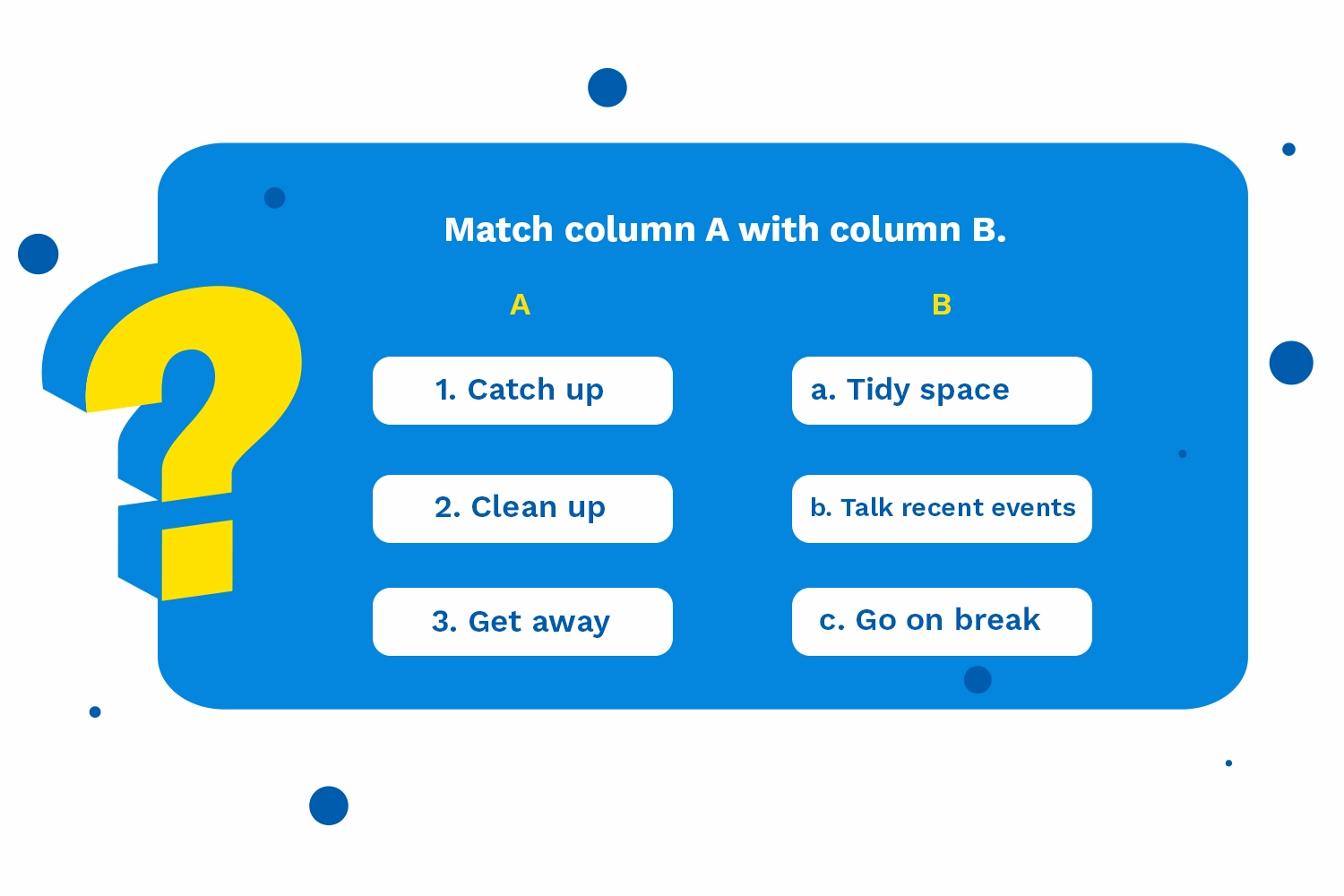
(Answers: 1-b, 2-a, 3-c)
Your Path to Fluency Starts Today!
Congratulations! You’ve unlocked 50 phrasal verbs for daily conversation! From “wake up” mornings to “make up” moments, these essential everyday phrasal verbs and common spoken English verbs are your fluency fuel. As daily vocabulary boosters, they’ll transform beginner stumbles into confident flows.
Remember: Fluency isn’t perfection; it’s practice.
Start small and use one in your next chat.
Ready to level up? You can message us on WhatsApp. Your natural voice awaits! What’s your first phrasal verb adventure?
Book any awesome EnglishFact course now or register to our FREE TRIAL ONLINE CLASS to improve.